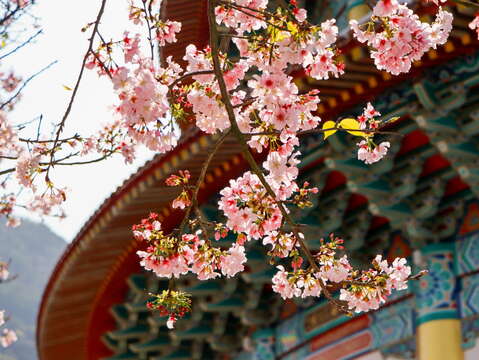
Temperatures rise and drop, and it is sometimes cloudy, and sometimes sunny. People do not know what to wear for unpredictable weather. However, it signals the full bloom of flowers in spring when the weather constantly changes! Tamsui and Sanzhi at the Northern Coast have gradually said goodbye to rainy winter to welcome pink cherry blossoms that come into blossom. You can admire Yoshino cherry blossoms that bloom after Taiwan cherry blossoms in Tianyuan Temple, a resort for admiring cherry blossoms. They announce the arrival of Spring God with their pinkish white flowers. Cherry blossoms by Maple Tree Lake, Sakura Path and Sanzhi Sansheng Trail awake from the stroke of the spring breeze, blooming under the clear sky.Located at the outskirt of Tamsui, Wuji Tianyuan Temple stands on the hill to the northwest of Datun Mountain. The magnificent temple faces the sea with the mountain in the back. Founded in 1972, the temple enshrines Jade Emperor. In 1992, the temple extended and constructed Zhenyuan Altar in the back mountain. The five-story sacred altar is 200 meters tall with a diameter of 108 meters. The grand and majestic architecture is the most well-known landmark on the hill of Tamsui. Undoubtedly, its gorgeous forest of cherry blossoms has made the temple even more famous. Cherry blossom trees that were planted when the temple was first founded have made it a much anticipated spot for admiring cherry blossoms in New Taipei City today thanks to temple workers who take good care of these trees.Cherry blossoms are grown in two areas at Tianyuan Temple. Taiwan cherry blossoms grown in the back mountain are pink, white and peach. They are usually in full bloom from late January to late February. Cherry blossoms grown around the altar are Yoshino cherry blossoms, and they are in full blossom around mid-March and late March. Cherry blossoms bloom all over the mountain set off the magnificent altar of Tianyuan Temple. The unique and elegant scenery has made the temple a beloved spot for photographers. They can take photos from diverse angles as the altar has been built on a slope.🌸Due to climate, the time for cherry blossoms to be in full bloom varies. You may check the latest flowering information on the websites of https://cpqweb.com/ntpciflower/and https://www.facebook.com/ntpcflowernews/?locale=zh_TW for more information.After admiring the beauty of the architecture of Tianyuan Temple and cherry blossoms, we come to Maple Tree Lake which is only five minutes away from the temple by car. Located inside Yangmingshan National Park, the lake which is surrounded by mountains on its three sides possesses the dreamlike scenes of Magnolia grandiflora, camellias and cherry blossoms. Maple Tree Lake has the largest forest of Magnolia grandiflora in Taiwan. Purple and pinkish white Magnolia grandiflora are planted by the lake. They are called “lotuses growing in the trees,” and are respected and loved by Buddhists. Moreover, they are important drug ingredients and spices. They are ornamental plants, and they provide benefits to humans as well.🌸The flowering season of Magnolia grandiflora is between early February and mid-March every year.16,000 cherry blossom trees were planted on Qingshan Road and Dahu Road successively nearly three decades ago in Sanzhi that is located right next to Tamsui. They include Taiwan cherry blossoms, double-layer cherry blossoms and Yoshino cherry blossoms, and they bloom in turn between late January and early April. They grow on both sides of the road, so it is called Sakura Path which is a popular spot for admiring cherry blossoms in Sanzhi. Landscape trails and observatories have been built for certain parts of the path. It is breathtaking to stroll on the flower path where the petals of cherry blossoms are flying all around.Sansheng Trail that is built along Dakeng River and paved with andesite is another renowned cherry blossom viewing path in Sanzhi. Over 300 double-layer cherry blossom and Yoshino cherry blossom trees have been planted along the 2-kilometer trail. Sansheng Trail combines “production,” “life” and “ecology.” The fields in farming villages are pleasing to see. You can walk on the wooden arch bridge to listen to the murmuring of the river, admire the falling of petals, and enjoy the happiness that belongs solely to spring.