Go to the main content section Anchor point

New Taipei City Travel

One-Day Tour to Jiufen Old Street

Anchor point
One-Day Tour to Jiufen Old Street
Category :
Nostalgic tour of the old street
Travel days :
1 day

推薦路線

Day

      Introduction

      Anchor point
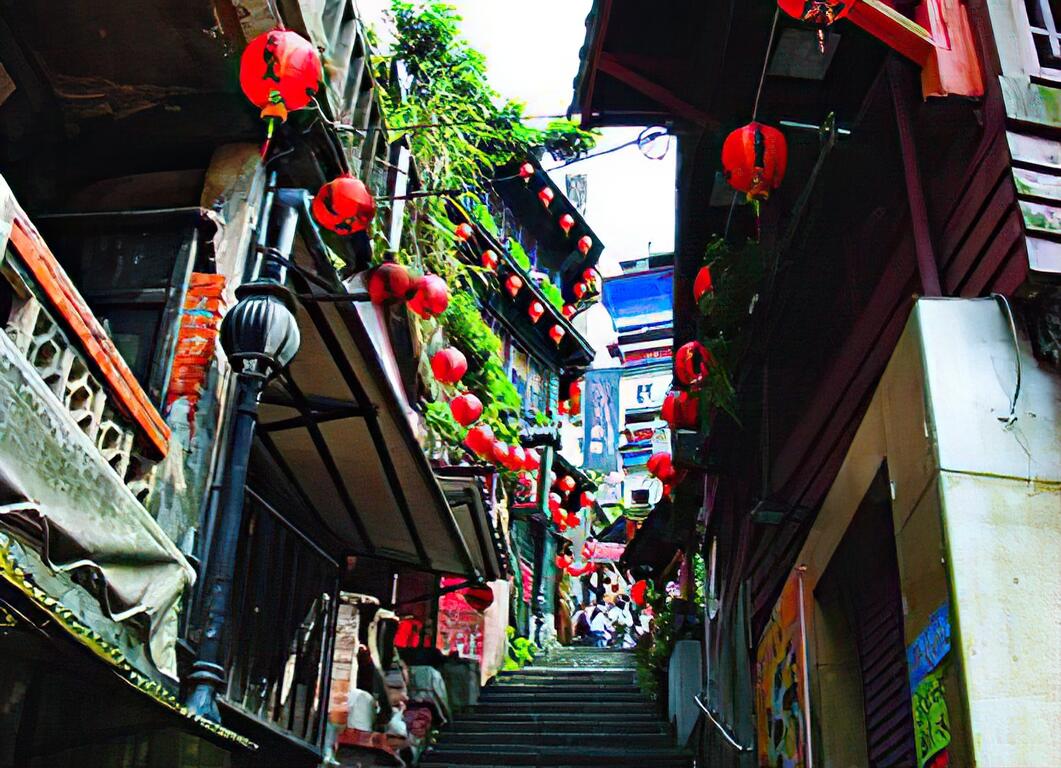
      Some people say that Jiufen became popular because of the movie “A City of Sadness”, but that is just what they might think because they have not experienced the wonder of Jiufen itself. Jiufen has not only preserved the old-style buildings from the Japanese Ruling Era, but most importantly it has the atmosphere of mountain city. Although the old street of today is always packed with crowds, but it is only in Jiufen that one may enjoy the fun of unique trails leading to the tranquil sceneries. One must have a bowl of taro tapioca balls when visiting here, but there are actually many other nostalgic snack food options here, forming a real-life story house with the three streets including Jinshan Street, Shuci Road and Cingbian Road, one may explore the splendid stories of Jiufen here, and may also enjoy delicacies while strolling around. If you have the time, take a trip to the Gold Museum, and you may further have a glimpse of the glorious gold refining days of the past.
      day01
        Previous
        Water Source Tea Fragrance・Pinglin Low-Carbon Journey
        As global carbon reduction gains momentum, the tourism industry works to lower emissions across all tour elements. From choosing meeting points and transportation methods, to incorporating environmental education and selecting eco-friendly restaurants, professional institutions now calculate carbon footprints using international standards. Unavoidable emissions are offset through purchasing Verified Carbon Standard (VCS) certified carbon credits, achieving genuine low-carbon tourism.Pinglin, renowned for producing Paochung tea, pioneered Taiwan's low-carbon tourism movement. Starting from Pinglin Suspension Bridge, the route follows Beishi River to the Taipei Water Management Branch Environmental Education Center to discover wastewater purification processes. At midday, visitors enjoy creative cuisine featuring local tea at Just Pinglin eco-restaurant on Pinglin Old Street. The afternoon continues at Xinfeng Tea plantation in Pinglin's hills, where young farmers share their lives devoted to tea.The journey begins at Pinglin Suspension Bridge. Spanning approximately 60 meters across Beishi River, this bridge connects fish-watching trails on both riverbanks. Led by a guide, visitors observe Taiwan shovel-jaw carp (a.k.a. "underwater fireflies"), and the river's rich aquatic ecosystem. The Beishi River watershed falls within the Taipei Water Conservatiopn Area. Policies such as river closure for fish protection and sediment barrier installations are implemented to safeguard water resources for the Taipei-New Taipei metropolitan area and extend Feitsui Reservoir's lifespan.At the fish-watching trail's end, behind flood walls stands Pinglin Wastewater Treatment Plant—one of two major treatment plants under the Taipei Water Management Branch and an environmental education venue. Designated in 1984, the Taipei Water Conservation Area spans five districts: Wulai, Shuangxi, Pinglin, Xindian, and Shiding. It’s Taiwan's only protected zone established in accordance with the Urban Planning Act, with merely 1% being low-density residential areas.Inside the Environmental Education Learning Center, visitors gain insight into Taiwan's water resource management and observe the treatment plant's three-stage process—physical, biological, and chemical purification that ensures discharge quality. Visitors collect water samples themselves, comparing influent and effluent quality for an intuitive understanding of purification's importance.At noon, visit Just Pinglin eco-restaurant at the entrance to Pinglin Old Street. Inside this stone-slab heritage building, savor dishes crafted with local tea—black tea braised pork rice, salmon ochazuke, and various tea snacks. A young man from Beigang and a young lady from Guanziling chose to settle in Pinglin, New Taipei, conveying the town's atmosphere and energy to travelers through cuisine, fine tea, curated items, and exhibitions.After enjoying refined tea cuisine, explore Pinglin Old Street with a guide. Stretching approximately 200 meters, the old street features teapot installation art and uniform green signage. Paper shops, tofu stalls, grocery stores, and tea merchants line the way. Street vendors use Pinglin's famous Paochung tea to create innovative treats—tea cakes, tea steamed buns, tea nougat, and camellia oil thin noodles."UChung," established by local young tea farmers, offers a modern compound tea space on the old street, selling tea snacks, tea gift items, and tea celebration wine developed exclusively by Pinglin tea farmers. This bright space hosts tea ceremony experiences from time to time, promoting tea culture in ways that resonate with younger generations. At a corner of the old street, Pinglin Tea Cultural Museum, operated by the Pinglin Farmers' Association, visitors will learn about tea and camellia oil culture while exploring Pinglin's tea history and other industrial features. Stone heritage buildings constructed with herringbone and T-shaped patterns offer another visual highlight along the street.Afternoon brings a journey to Pinglin's hills. Near Xiangong Temple, famous for sunrises and seas of clouds, sixth-generation young tea farmer Zhan Chengde of Xinfeng Tea guides visitors through verdant tea plantations to pick one bud with two leaves, then hand-craft and taste their own tea.Xinfeng Tea is known for its "friend tea," aimed to convey warmth and authenticity. After picking tea leaves, participants personally stir-fry and knead them under the farmer's guidance to create their own green tea! Through the journey from a plantation to a cup, savor Pinglin tea town's distinctive flavor.The "Water Source Tea Fragrance・Pinglin Low-Carbon Journey" meets the Ministry of Environment's "Green Tourism" standards and appears on the "Green Lifestyle" information platform. Carbon footprint calculations show this tour produces 11.5 kg CO2e per person, reducing emissions by 5.6 kilograms compared to typical self-driving tourism.
        Next
        “Laomei turns green!” Touring Shimen during the vigorous spring.
        “Laomei turns green!” is a warm greeting full of vitality on the north coast. From the middle of March to early May each year, the coastline of Shimen District, which is situated in the northernmost end of Taiwan main island, is decorated with reefs covered in green algae, turning it into a stunningly beautiful matcha green carpet. It also represents the arrival of the God of Spring in this rainy land and the season for travelling on the Norther Coast. Let’s visit the coastline of Shimen to explore the vigorous green troughs, play hide and seek in the maze of Laomei, and fly kites on the coast to enjoy the warm and pleasant scenery of Shimen!The “Xingfushuangxin Park” (literally referred to the “Happiness Double Heart Park”) newly established in 2022 has adopted the traditional “khan-koo” fishing technique (literally referred to “seine-fishing technique”) to create the installation art “The Khan-Koo Dream Weave”. Through the giant stainless-steel framework fitted with colorful glass pieces, this design presents changes in light and shadow under the spring sun’s shine as our perspectives and time shift. There are also specially designed interactive experience facilities, such as the conch sound-controlled lift system, a square featuring the imagery of a lighthouse man, and sampan-shaped seating. Reputed as the most beautiful park on the north coast, all visitors, including children, can find fun here.The stone troughs formed by volcanic reefs that remained on the coast after the eruption of the Tatun Volcano Group are covered with a large amount of algae during the spring of each year, turning the earth-gray reefs into a lush and natural wonder of greenery. Alongside the crystal blue ocean, this matcha mochi-like unique landscape has attracted numerous photography enthusiasts coming here. At low tide, small ponds also form between the rocks, allowing visitors to observe fascinating marine life. Before your departure, you can browse the tide forecast for Shimen released by the Central Weather Bureau to capture the beauty of lush green troughs at the right low tide timing!Laomei stone troughs, commonly known as “Laomei Green Reef”, feature fine sandy beaches and creatively shaped rocky shores, resembling rows of slender green dolphins basking on the beach. Stone troughs are formed by volcanic reefs, which are ideal for algae to attach to and grow. After the algae die, their remains will form thin layers of limestone, and new algae will attach to this layer. As algae continue to die and attach to the new layer, they eventually create this beautiful algae reef. When coming there to relish the beauty of green reefs, please remember not to stand on the stone troughs. Let’s contribute to the sustainability of the local ecology.In the windbreak behind Laomei Beach, red-brick walls have created winding and intricate pathways. This transforms Laomei Green Reef into something resembling an extraterrestrial relic and a must-visit popular photo spot on the North Coast. Apart from challenging your sense of direction and memory on your own in the maze, you can also play or enjoy a game of hide-and-seek with your friends and family inside.Characterized by black and white stripes, the Fuguei Cape Lighthouse that stands erect between the mountains and ocean is the northernmost lighthouse on the Taiwan main island. Since its establishment in 1897, it has been faithfully guarding vessels passing through the north coast. When the sun sets, looking eastward from the west side of the lighthouse, you'll see the fiery red afterglow reflected on the lighthouse, creating a magical spectacle that photography enthusiasts eagerly seek.“With soaring spirits into the clouds, we joyfully fly kites, hoping to reach the highest heavens. To ascend the kites on high, it all depends on the thread held in our hands.” This Chinese poem written by the Kaitai Imperial Scholar, Zheng Yong-xi, describes the scenery of the millennia-old flying kite activity. Situated on the windward side of the northeast monsoon, Shimen is reputed as “The Homeland of Kites” as the strong sea breeze has created an excellent environment for flying kites. Shimen, serving as the host location for the annual Taiwan International Kite Festival, draws in numerous foreign and domestic skilled kite enthusiasts each year. Pick up your own kite and run against the wind. Let's join the colorful kites to soar amidst the breathtaking scenery of Shimen's sea and sky.
        Read more
        Back to the top of page
        小客帶路